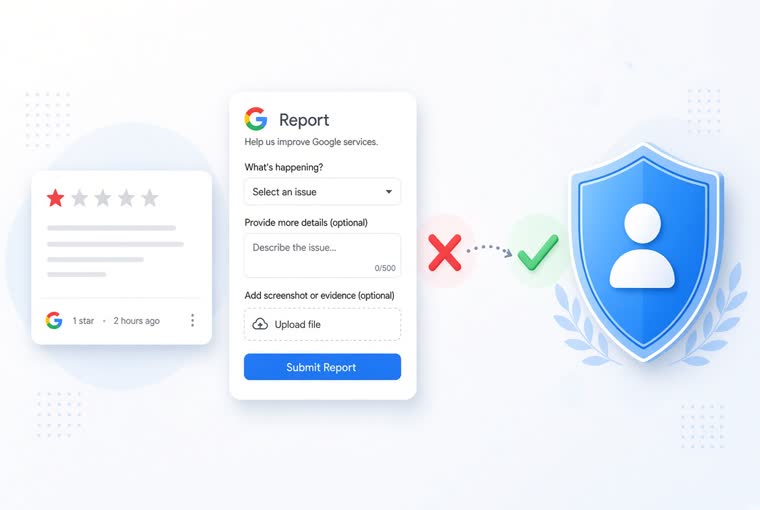
How to report a fake Google review
What Google actually removes, three ways to report, how long it takes, what to do when rejected. And why "guaranteed removal" is itself the warning sign.
ReadHome / Review Guide / Can it be deleted
First work out which of the three kinds you are holding. Only one of them can really be deleted; the other two cannot, however much time you spend on it — but both have another way out.
The reason this question never gets a straight answer is that three different things get discussed as one. Separate them first:
In practice the third kind is the overwhelming majority. So the right question is not “how do I delete it” but “which ones are worth chasing, and what do I do about the rest”. That is the order below.
Google removes reviews that break its own content policy, not reviews that embarrass you. These genuinely are reportable:
You report from inside your Business Profile, one review at a time — never in bulk. Which fields to fill, what wording gets through, how long it takes, and where you can escalate after a rejection are all in How to report a fake Google review. Set your expectations low first: the success rate is not high and a rejection is normal. But report anyway — it is the only removal route Google recognises.
If Google only removes what breaks its own policy, what exactly is a firm promising “guaranteed removal, no win no fee” relying on? There are only a few plays, and every one of them is charged to your account, not theirs:
They all share one feature: they are betting your Business Profile, and if the bet loses it is your profile that pays. A suspended profile does not cost you one bad review, it costs you the whole page — how long recovery takes is in Google Business Profile suspended? What to do.
Outside Google, the only person who can make a genuine bad review disappear is the customer who wrote it. Authors can edit or delete their own reviews at any time. So the point is not how to talk them into it — it is how to fix the problem thoroughly enough that they want to.
“About the wait you mentioned last week: weekend queueing is now handled by text alert, and your bill has been refunded in full. Sorry for the trouble. Ask for me next time and I will hold a table.”
Not one word of that mentions the review. It does two jobs: it fixes the problem, and it makes sure everyone who reads the bad review from now on also reads how you handled it. Do not start typing in the first hot minute — the first step is in You got a one-star note. Now what?
Accept that the genuine bad review is going to stay. But staying and still doing damage are two different things. When the next customer reads it, their eyes land on your reply. A measured, specific reply that takes the problem on beats deleting the review, because it proves the place deals with things when they go wrong — deleting only makes the page look like nothing ever went wrong. What to write, how long, and what never to say are in How to respond to Google reviews: ten templates you can copy.
Something else quietly helps you: Google sorts reviews by relevance and recency by default, so new reviews push old ones down. A bad review still on the first screen three months later is usually there because nothing new arrived in those three months, not because Google is favouring it.
This part is calculable. If T is the rating you want to hold and the bad review is worth v stars, the number of five-star reviews x you need satisfies x ≥ (T − v) ÷ (5 − T). Note what is not in that formula: how many reviews you already have. The number of five stars you need is independent of your total — it depends only on the rating you are trying to hold. For a single one-star:
| Rating you want to hold | Five-star reviews needed to recover |
|---|---|
| 4.9 | 39 |
| 4.8 | 19 |
| 4.7 | 13 |
| 4.5 | 7 |
| 4.0 | 3 |
Two things follow. First, a high rating is expensive to hold: defending 4.9 costs more than five times what defending 4.5 costs, so a 4.9 business should worry less about climbing and more about not slipping. Second, for most businesses the number is not frightening — at 4.5, seven five-star reviews puts you back, which is a week or two of normal footfall. To run it on your own rating and review count, use the Star rating calculator.
Deletion is a narrow road, and it is not yours to decide. What is yours to decide is the other two: fix the problem, and keep real customers talking. How to do the second one systematically is in How to ask customers for Google Reviews, and What a good review is actually worth to you does the maths on why it pays.
What Google actually removes, three ways to report, how long it takes, what to do when rejected. And why "guaranteed removal" is itself the warning sign.
Read
What to do in the first 24 hours, a reply template you can copy, and four things never to write.
Read
Google shows one decimal place, and the bigger your denominator the harder it moves. Real numbers on how it is calculated, how close you are to dropping a notch, and why chasing the score is the wrong first move.
ReadCreate an account, add your location, and five minutes later the QR code is printed and sitting on the counter.