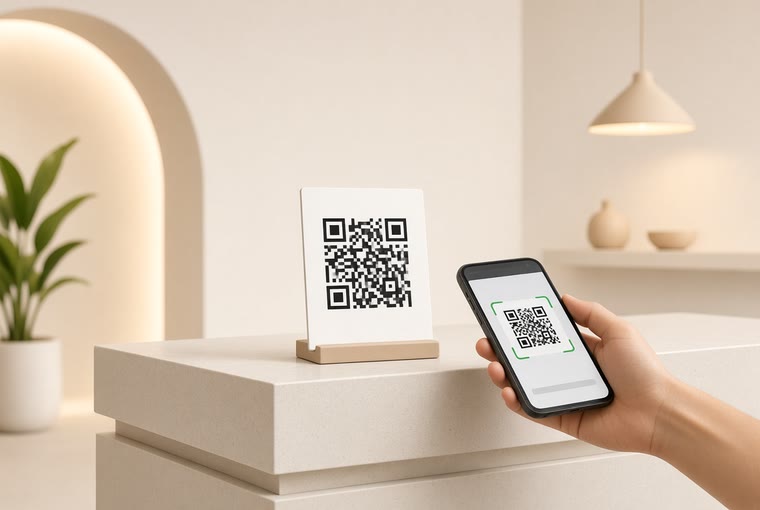
This trade has an advantage no other has: the customer sits in your chair for forty minutes, and at the end the result is right there in the mirror.
Why reviews are worth more in this trade
Choosing a salon and choosing a restaurant are not the same decision. A bad meal is over in two hours; bad hair follows you for three months. The harder a mistake is to undo, the more reviews people read before choosing.
There is a second layer: this trade has high repeat frequency — nails every three or four weeks, hair every month or two. One new customer is a dozen or more visits a year. So a review here is worth considerably more than “one extra customer” makes it look.
The moment to ask
Other trades have to hunt for the moment. Here it is already built into the service — the second the customer looks in the mirror.
The second you turn the chair and show them the mirror. The emotional peak of the whole visit, and the first time they see the finished result. Asking here converts several times better than asking at the till.
Do not wait for the till. By then they are reaching for their phone to pay and already thinking about the next thing. Their attention has left.
The few minutes while polish dries. Nails have a window nothing else has: they cannot leave, their hands are occupied, but their eyes and their mouth are free. Those minutes are a gift.
Ask the ones with a new colour or a big change first. The bigger the change, the more they want to say something — and the more likely they are to photograph it.
Three lines you can use as-is
No script to memorise. Pick one of these. What matters is that it gets said, not that it is said elegantly.
“Happy with it? If you are, would you mind saying so on Google? Scan this — thirty seconds.” The most direct one, for the mirror moment. Asking whether they are happy first gives them room to say “not quite” — and that is the answer you need more.
“That colour really suits you. If you have a minute, a line on Google helps — a small place like ours lives on it.” A genuine compliment, then the honest reason. The second half works better than any script, because it is true.
“You have five minutes while that dries — want to scan this while you wait?” Slots the request into time they were already going to spend. There is almost no reason to say no.
Three traps specific to salons
Letting only your most outgoing stylist do the asking. Every review names the same person, and the rest of the team quietly stops bothering. Let each person ask their own clients. Different names in the reviews read as more genuine, and it keeps staff invested.
Taking the customer’s phone and doing it for them. This trade is especially prone to it — wet polish, awkward hands. But posting on someone’s behalf is a clear violation, and when they later see words they did not write, it sits badly. Better they do not write it at all today.
Only mentioning it when the work came out exceptionally well. That is review gating, which Google prohibits. It also backfires in practice: one four-star review from someone who thought it was fine is more convincing than ten fives.
The two most common bad reviews
“It does not look like the photo I brought.” The most frequent complaint in this trade, and eight times out of ten it is not a skill problem — it is expectations that were never aligned. Do not explain the technical difficulty. Acknowledge the gap, then offer something concrete: “The photo you brought was that length with extensions, and we should have said so up front. Come back in and I will adjust it for you, no charge.” The words that matter are “no charge” and “come back in.” The rest is filler.
“It chipped / faded within days.” Find out how many days first. Inside three, that is workmanship or product — own it and redo it. Beyond two weeks, that is normal wear, but do not lecture the customer about it in public. The public reply says only “that is not normal, please come back and we will redo it free.” Everything else you say in person.
Where you can be in thirty days
A salon with two or three stylists sees maybe a dozen clients a day. Ask every one of them at the mirror, land one or two a day, and that is thirty to forty a month. That is not a best case; it is what happens when this one action is done consistently. There is only ever one reason it does not: nobody remembered to ask. So put it on the checklist instead of relying on memory.
In this trade the customer arrives already worried about being taken advantage of. The best moment is at handover after explaining the work — plus how to answer “it broke again” and “the bill did not match the quote”.
Read
Healthcare
How a clinic builds reputation without crossing a line
Where the boundaries sit for medical practices, what the front desk should say, and what must never appear.
Read
Where to put the code
Where to put your review QR code so people actually scan it
When nobody scans the code, it is almost always the placement. Seven spots and who each suits, three that waste your money, how big to print it and on what, and why the one sentence a staff member says matters more than the code.
Read
Free right now
Reading it helps. Doing it helps more.
Create an account, add your location, and five minutes later the QR code is printed and sitting on the counter.