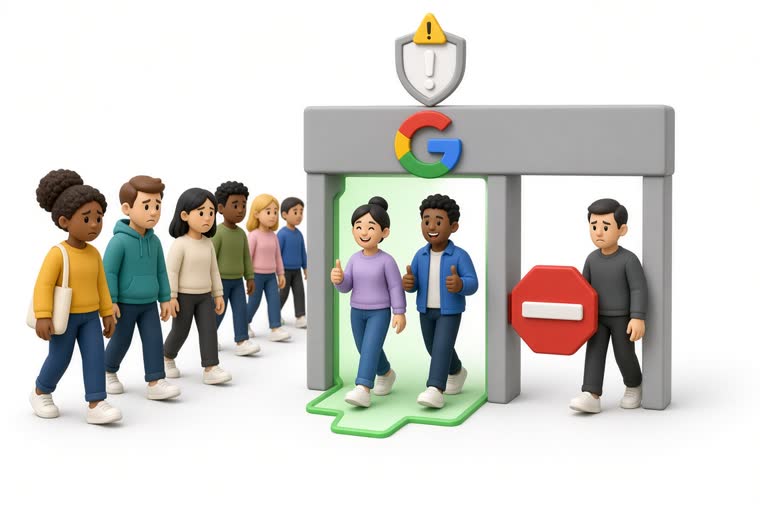
Why you cannot ask only your happy customers
Filtering by satisfaction is called review gating. Google bans it and almost every business does it by accident. What it looks like, how Google finds it, and why it does not even pay.
ReadGoogle's review policy is blunt about this: you may not offer anything of value in exchange for a review. A discount, a free side dish, an entry into a prize draw, a coupon for next time, cash — the moment "write a review" is tied to "get something", the line has been crossed.
Plenty of owners think: I never asked them to lie, they really were happy, I am only saying thank you. That is a reasonable instinct, but Google is not policing whether the content is true. It is policing whether the motive behind the review has been contaminated by a transaction. Once a benefit is attached, the review stops counting as spontaneous.
That last one catches the most people out. It has a name - review gating - and while it feels merely shrewd, Google lists it explicitly as a violation, because it distorts the rating systematically.
This part matters: the consequences land on your own Google Business Profile, not on whoever helped you do it.
A service provider can change domain and carry on. You have exactly one Google listing. Which is why any arrangement that keeps the revenue and hands you the risk is a bad deal.
Plenty of owners file this under "Google's rules" and assume the worst case is losing some reviews. In the United States that reading is out of date.
The Federal Trade Commission finalised its Consumer Review Rule (16 CFR Part 465) in late 2024, making several practices unlawful outright, among them:
The rule carries civil penalties of up to $51,744 per violation. Enforcement began in late 2025, and businesses have been receiving warning letters.
What matters here: this runs independently of Google's own penalties, and both can land at once. Google removing your reviews and restricting your profile does nothing to settle the FTC side, and vice versa.
So "worst case, I lose some reviews" gets the arithmetic wrong twice: it underrates the platform side (see Google Business Profile suspended? What to do for what a suspension actually costs) and leaves the federal side out entirely.
This is background, not legal advice. For your own situation, talk to a lawyer.
Quite a lot, and it works about as well. What these all have in common: they lower the effort, they do not change the intent.
No QR code yet? Our free Google review link generator will produce one from your Maps link. No signup.
Are you changing how easy it is to write, or whether they write and what they say?
The first is fine. The second is not. Test anything against it:
That is against the rules. Google does not accept review removal as a service, and no provider has the power to delete somebody else's review. All they can do is walk through the same reporting process you can walk through yourself - and You got a one-star note. Now what? Paying does not raise the success rate.
More to the point: if they start filing bulk reports or inventing grounds to make something happen, it is your account that answers for it, not theirs.
Playing by the rules sounds like a constraint. It is mostly a saving. The gain from breaking them is one-off; the cost keeps coming. Lowering the effort is slower, but the reviews it earns do not vanish overnight.
One thing you can do today: settle on the sentence you will use, and pin it up by the till for staff to read. No tool, no budget needed. If you then want that last step to be shorter, set up a free QR code - the first three at each location are on us.
Filtering by satisfaction is called review gating. Google bans it and almost every business does it by accident. What it looks like, how Google finds it, and why it does not even pay.
Read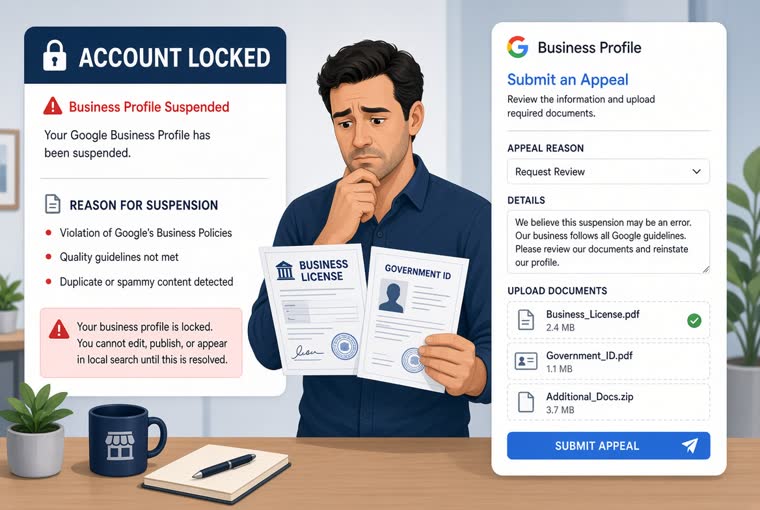
Soft and hard suspensions need different handling. Seven triggers, the full appeal, what evidence to prepare, and three things never to do while waiting.
Read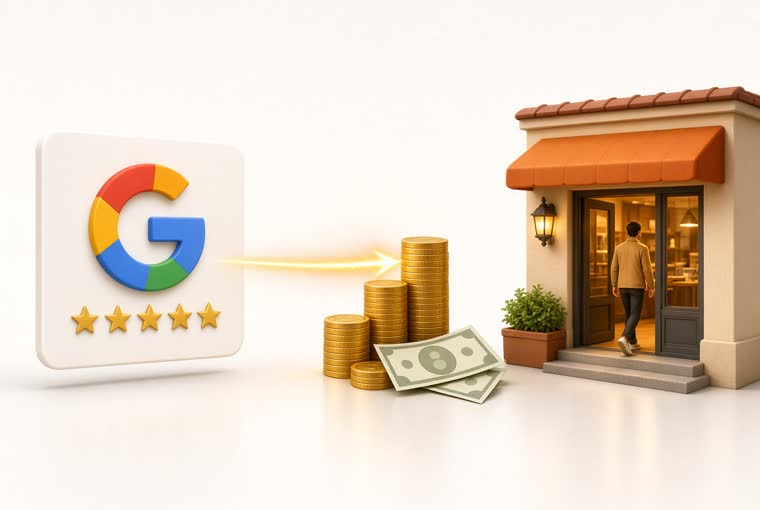
Reviews are not a vanity number. They feed your Google Maps ranking, decide who gets clicked at the same position, and put your customers own words into the search index. Here is the chain from a review to a paying customer.
ReadCreate an account, add your location, and five minutes later the QR code is printed and sitting on the counter.