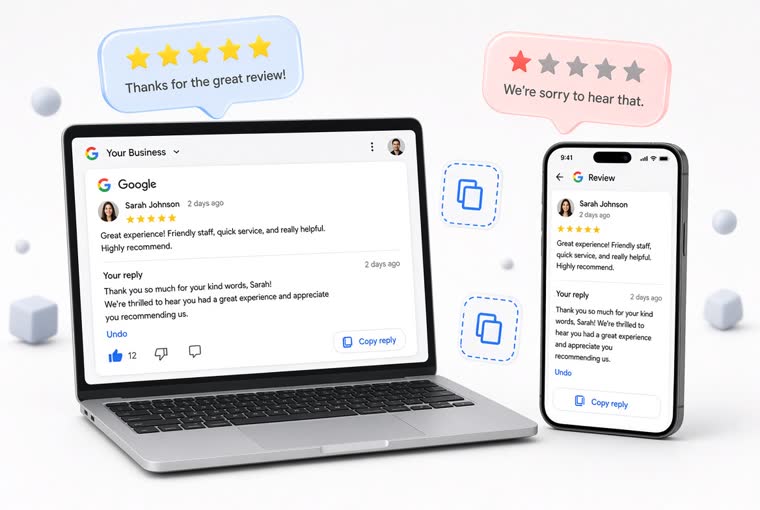
How to respond to Google reviews: ten templates
Five replies for good reviews, five for bad, ready to use. Plus three sentences never to write.
ReadGoogle removes only what breaks its content policies — spam, personal attacks, content unrelated to an actual visit, obvious conflicts of interest. A politely worded one-star entry from a genuine customer will survive every appeal you file. Vendors promising guaranteed removal are gambling or doing something worse.
Once that sinks in the problem simplifies: you are not managing the entry, you are managing the next person who reads it.
“Thank you for taking the time to tell us. We checked [the specific problem] with the team who were on that day, and you are right that we fell short. We have since [the specific fix]. If you are willing, please reach us at [email or phone] — we would like the chance to put it right in person.”
Three things make it work: naming the actual issue rather than apologising vaguely, stating what changed rather than promising to take it seriously, and offering a route to continue the conversation offline.
If the content contains abuse, discrimination, advertising, material unrelated to your business, or clearly comes from somebody who never visited, report it from your Google Business Profile. Manage expectations: the success rate is low, and repeatedly resubmitting the same report achieves nothing.
Do the arithmetic. One one-star entry drops the average about 0.2 points when you have twenty in total, and about 0.02 points when you have two hundred. So the answer is always the same: keep genuine praise arriving. That protection is bought beforehand, not afterwards — see What a good review is actually worth to you for the rest of the arithmetic.
That is the only thing Review Helper does — compress the effort down to thirty seconds so the denominator grows. Once it is large enough, a single bad entry stops being a crisis and becomes a rounding error.
When three different people report the same thing, it is not that customers are difficult — your process has a hole. Waiting times, parking, language, and queueing at the till are the four that come up over and over.
One thing to do today: put your last three negative reviews side by side and look for exactly one thing — whether the same problem is named by two or more different people. If it is, go fix that first; the reply matters less. How to respond to Google reviews: ten templates you can copy covers the wording. And if the review is not from a real customer at all, use How to report a fake Google review rather than arguing in public.
Five replies for good reviews, five for bad, ready to use. Plus three sentences never to write.
Read
Only one of the three kinds can really go. What "guaranteed removal" services actually do, how to get the customer to take it down, and the arithmetic of recovering your rating.
Read
Google shows one decimal place, and the bigger your denominator the harder it moves. Real numbers on how it is calculated, how close you are to dropping a notch, and why chasing the score is the wrong first move.
ReadCreate an account, add your location, and five minutes later the QR code is printed and sitting on the counter.